Somebody wrote your product description in a meeting. Somebody else approved it. Neither of them had bought the product.
Meanwhile a few thousand people who did buy it have written down, in their own words, exactly what made them keep it, what nearly stopped them, and what they did not expect. That writing is sitting on your own product page, underneath the description that is not working.
Below is the whole rewrite, end to end, from nothing but your reviews and your current copy. Four prompts, each one a single message you can paste. What comes out is a title, a description, three bullets and a buy button line, with every phrase traceable to a real review.
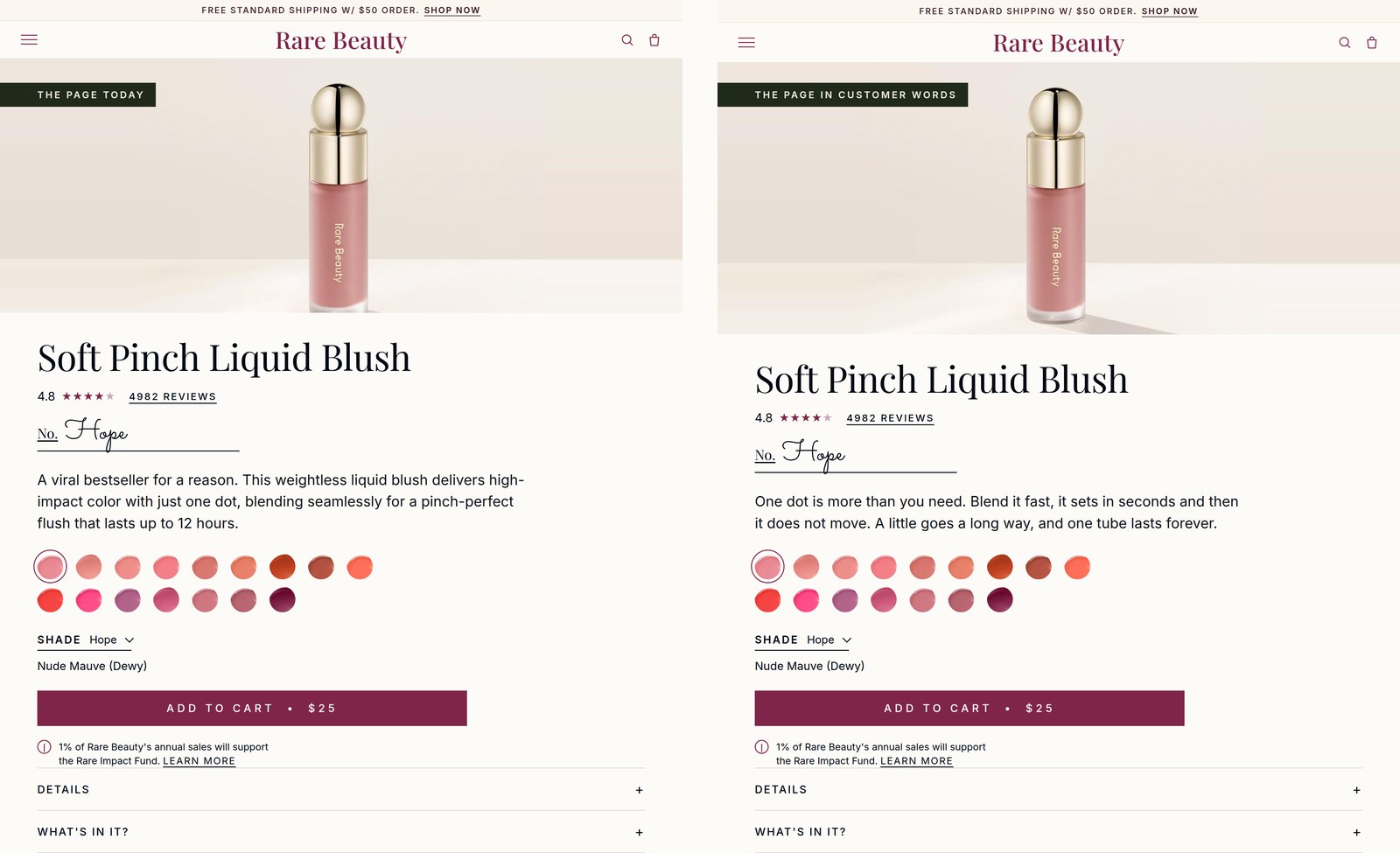
Same page, same product, same photoOnly the description changed.
What do you need before you start?
Two things, and you already have both.
- Thirty reviews for one product. Every star rating, not just the fives. The threes and fours are where the objection lives, and the objection is the most useful thing in the pile.
- Your current page copy. The title, the description and the bullets exactly as they are live right now. This is what you are measuring against.
You do not need a copywriter, a survey, a customer interview, or a research tool. You need Claude and about twenty minutes.
Where do you get 30 reviews?
Wherever they already are, and you do not have to tidy them up.
- On Shopify. Judge.me, Okendo, Yotpo and Loox all export to CSV from the app dashboard. Drag the file straight into the chat.
- On Amazon. Seller Central has a Voice of the Customer report.
- No review app at all. Copy them off your own product page, and off your Sephora, Ulta, Target or Amazon listing if you are stocked there. Retailer reviews are usually longer and more honest than the ones on your own site.
Keep the star rating and the source next to each one. That is the only formatting that matters, because it is what lets you sort the objection from the praise later.
Do not clean them up. The typos, the caps, the run on sentences and the odd phrasing are the data. The moment you tidy a review into brand language you have deleted the thing you came for.
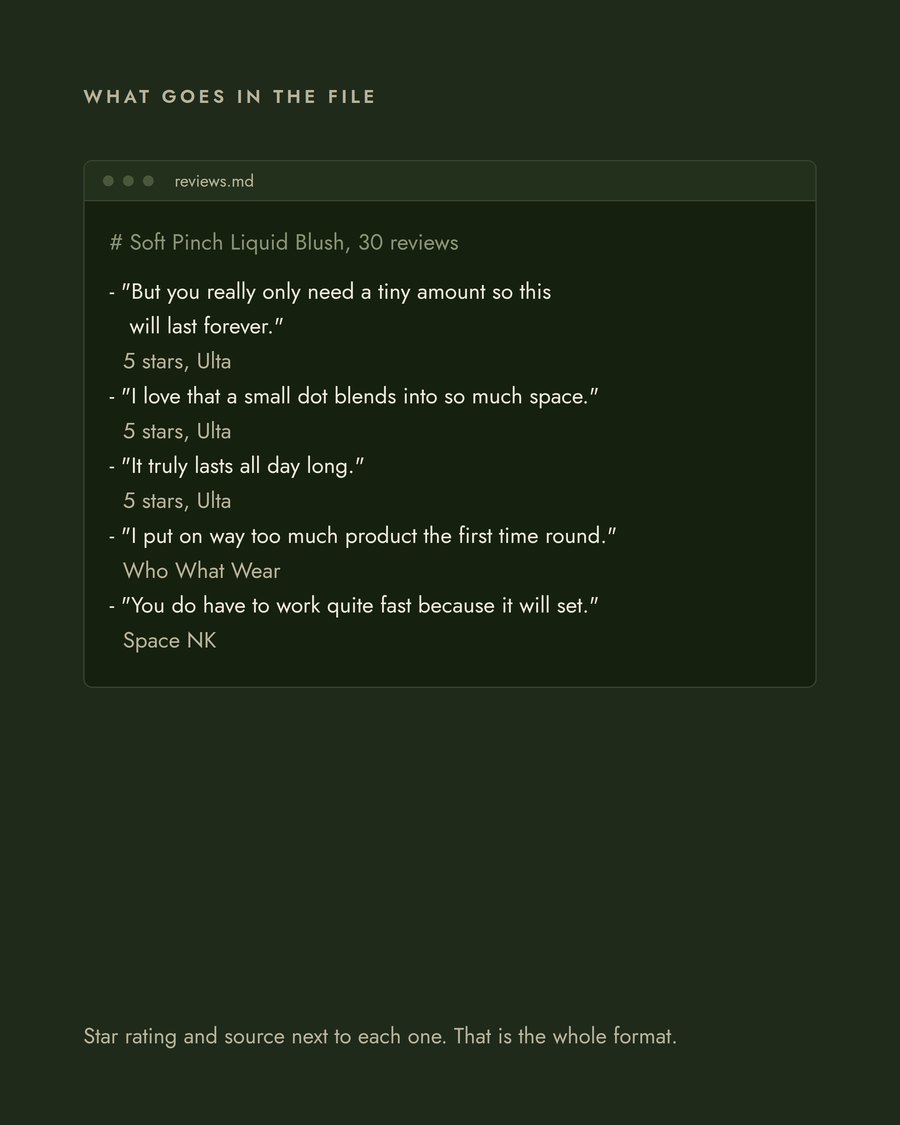
The whole file formatOne review per line. Star rating and source underneath. Nothing else.
What do you ask Claude to find?
Four things, and only one of them is the one everybody asks for.
| Step | What you do | How long |
|---|---|---|
| One | Hand over the reviews and your current copy | 3 minutes |
| Two | Ask what repeats, what the objection is, what surprised them | 4 minutes |
| Three | Ask for the rewrite | 3 minutes |
| Four | Make it show you the source for every phrase | 4 minutes |
Step oneHand over the reviews and your current copy
Both at once, in the same message. The comparison between them is where the whole method lives, and a model that has only seen the reviews cannot tell you which of your words no customer has ever used.
That second line is doing more work than it looks like. Without it, a model will happily blend what it already knows about a well known product into the answer, and you will end up with a phrase no customer of yours ever wrote.
Step twoAsk what repeats, what the objection is, and what surprised them
Most people ask for a summary of their reviews and get back something that reads like a survey result. Ask for these four instead, because each one turns into a specific line on the page.
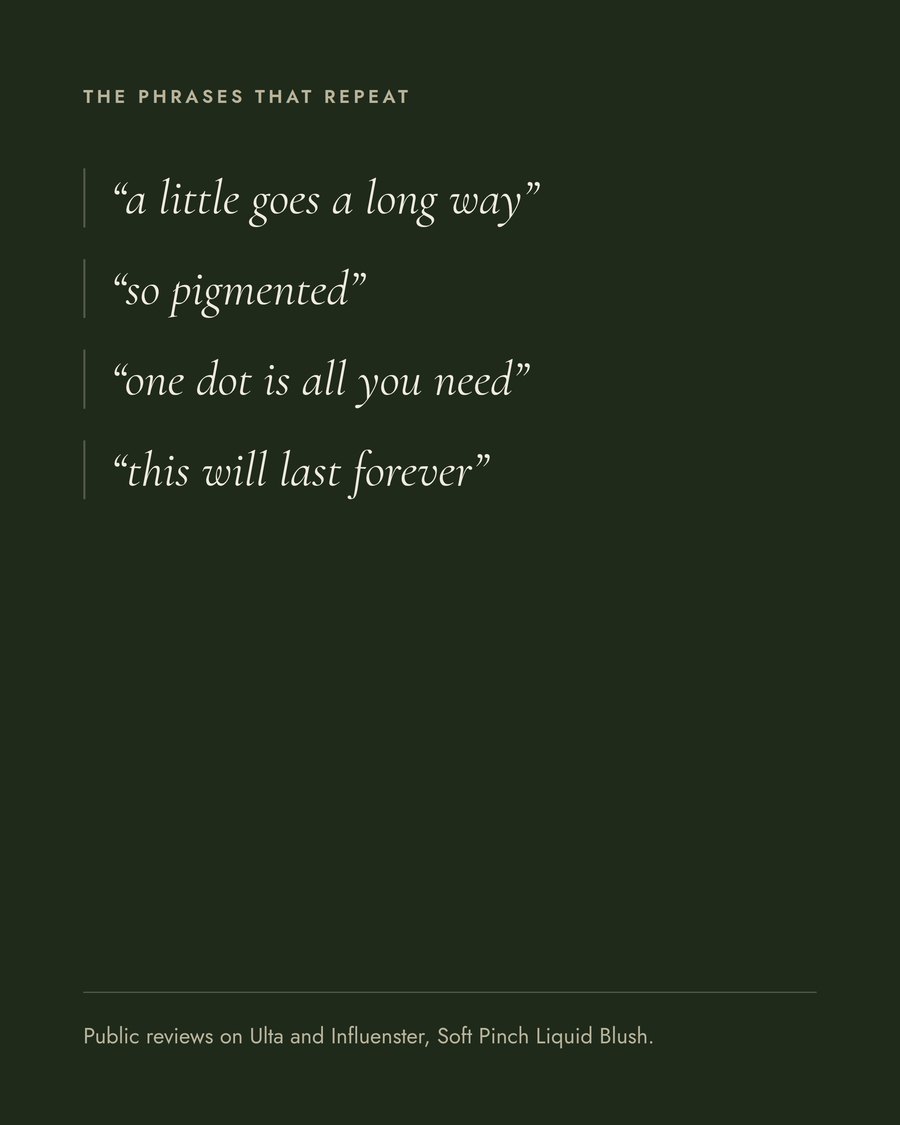
What repeatsThe phrases you stopped noticing.
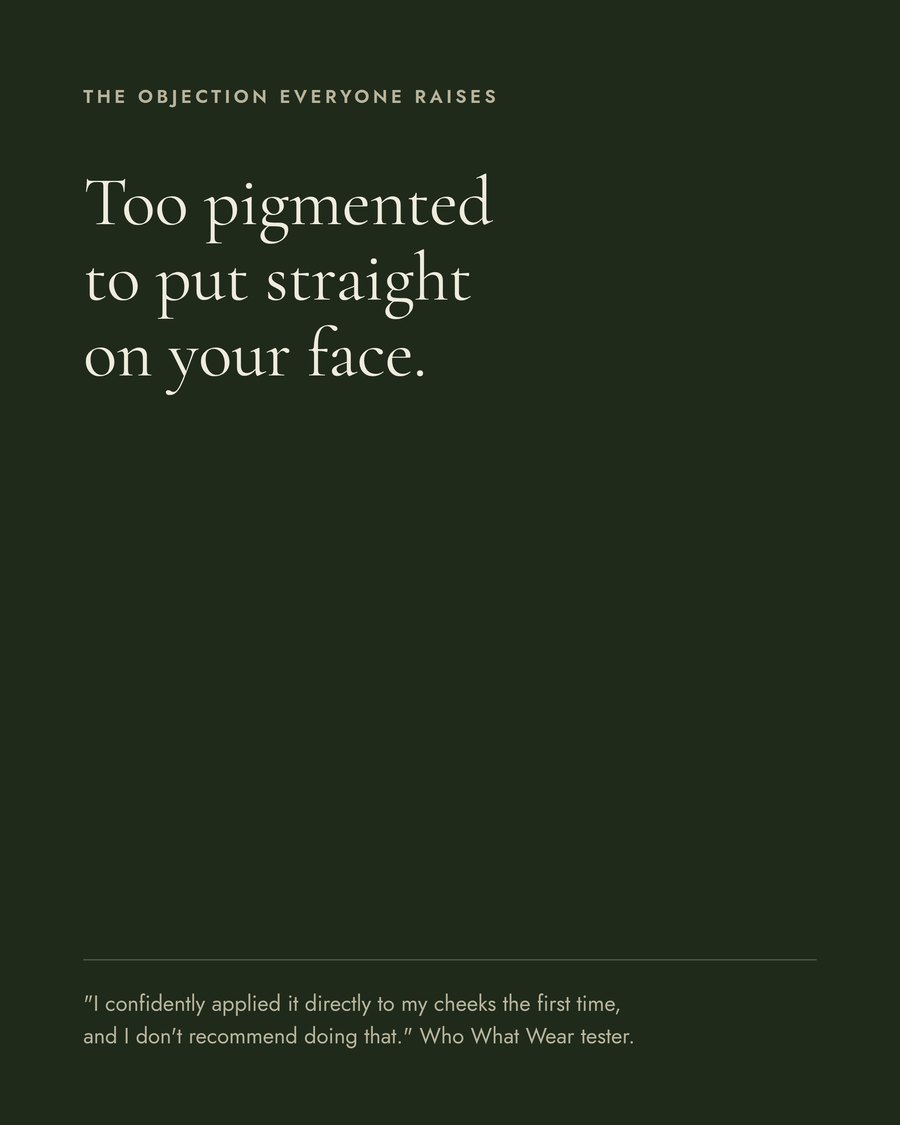
The objectionThe one your page is not answering.
The fourth list is the uncomfortable one. It is every word on your page that no human being who bought your product has ever used about it. Elevated. Curated. Essential. Redefines. Read it once and you will not write them again.
Step threeAsk for the rewrite
Now the constraints. Each rule below exists to stop a specific failure, and the last two are the ones that keep the page honest.
Forty words is not a style preference. A description longer than that is a description a shopper scrolls past on a phone, and everything you needed to say fits inside it once the dead adjectives are gone.
The rewrite in placeEvery phrase in it came out of a review.
Step fourMake it show you the source for every phrase
This is the step people skip, and it is the one that decides whether you can put the page live. A model that has been asked to write in customer language will occasionally write a line that sounds exactly like a customer and came from nowhere.
Ask to be shown the evidence rather than told it passed. A model asked to produce the source for each line removes its own invented ones on the way, which is a more reliable fix than catching them yourself afterwards.
OptionalDo the rest of the catalogOptional
The method is the same for every product. What changes is that once you have run three or four, a second pattern appears above the product level.
What does this look like on a real page?
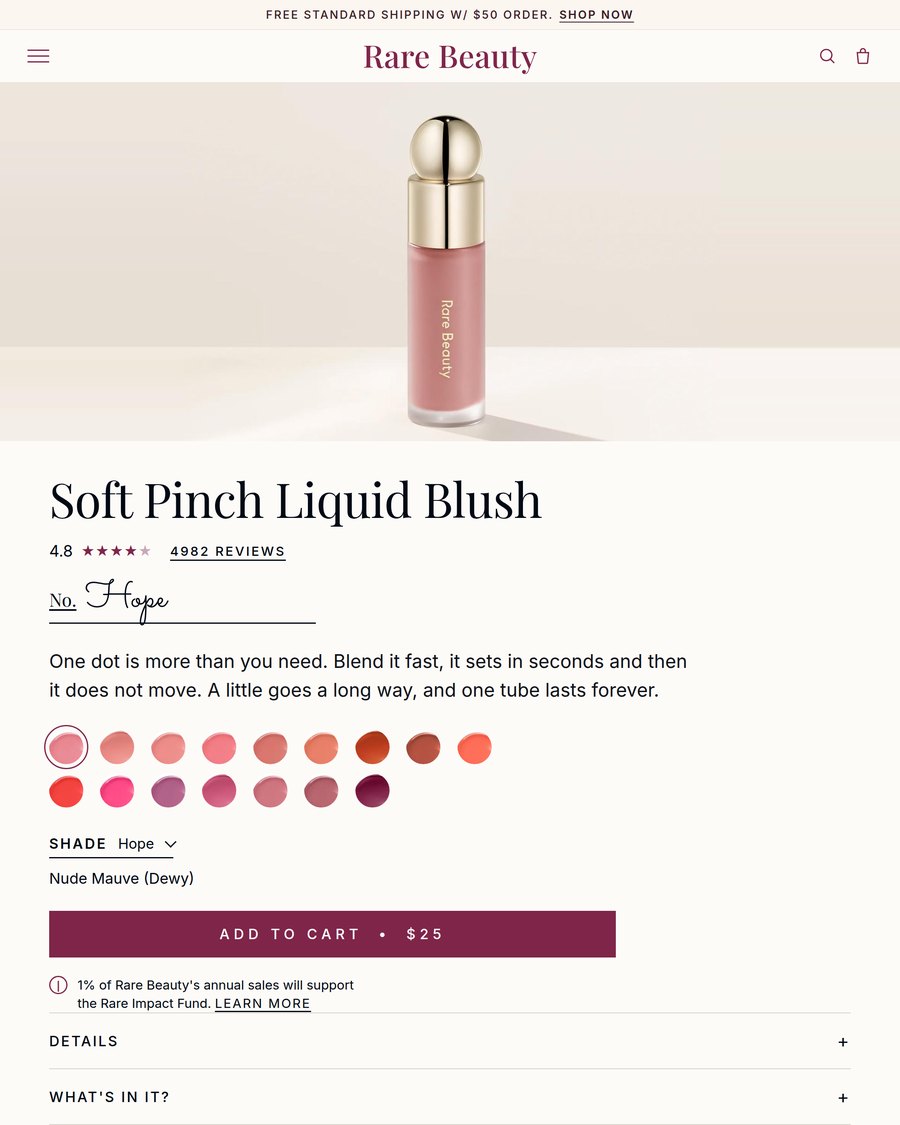
I ran it on a product page anyone can go and read: the Rare Beauty Soft Pinch Liquid Blush. It carries 4.8 stars from 4,982 reviews on the brand's own site, another 3,591 on Ulta and 12,593 on Influenster, which makes it about as well documented as a product gets.
Here is what the reviews say, in order of how often it comes up. A little goes a long way. So pigmented. One dot is all you need. Lasts all day. This will last forever.
Here is the objection, which comes up as a warning to the next buyer rather than a complaint. It is pigmented enough that first time buyers overapply, and it sets before they finish blending. A tester at Who What Wear put it plainly: "I confidently applied it directly to my cheeks the first time, and I don't recommend doing that."
And here is the gap. The brand's own instruction on the page says to place one to two dots on each cheek. What buyers say, over and over, is one dot total, applied to the back of your hand and picked up with a brush. The page's own instruction is what produces its most repeated complaint.
| What the page says | What the reviews say | |
|---|---|---|
| The description | "A viral bestseller for a reason. This weightless liquid blush delivers high-impact color with just one dot, blending seamlessly for a pinch-perfect flush that lasts up to 12 hours." | A little goes a long way. So pigmented. One dot is all you need. Lasts all day. This will last forever. |
| The objection | Not mentioned anywhere on the page | The single most repeated thing in the pile |
| How to apply | Place one to two dots on each cheek | One dot total, on the back of your hand, picked up with a brush |
Run the four prompts on that and the description comes back as this.
One dot is more than you need. Blend it fast, it sets in seconds and then it does not move. A little goes a long way, and one tube lasts forever.
Thirty words. Every phrase in it is traceable to a public review, and the objection is answered in the second sentence instead of being left for the shopper to discover in the review section.
That is the argument for the whole method in one example. Nobody at that brand is careless. The instruction on the page is simply what the product team believed, and five thousand people have since written down something different.
What is the prompt chain?
In order, so you can run the whole thing without stopping to think about what comes next.
| Prompt | What it does | What you get |
|---|---|---|
| One | Takes your reviews and your live copy | Both in one place, nothing invented |
| Two | Reads for four things, not a summary | Phrases, objection, surprises, dead words |
| Three | Rewrites under constraints | Title, description, bullets, button line |
| Four | Makes it show its sources | A review under every phrase |
| Five | Repeats for the next product | The rest of the catalog, plus brand level phrases |
What makes the difference?
- Include the bad reviews. The fives give you the phrases. The threes and fours give you the objection, which is the only part of this that changes a shopper's mind.
- Hand over your current copy in the same message. Without it there is no fourth list, and the fourth list is the one that changes how you write from now on.
- Answer the objection on the page. If a shopper has to go and find it in the reviews, you have sent them somewhere you do not control.
- Quote nothing that is not in the file. One invented customer line is worse than a dull description, because it is a claim you cannot stand behind.
- Do not paraphrase the phrase that repeats. "A little goes a long way" is the sentence people wrote. "Highly concentrated formula" is the sentence you would have written, and it is why the page was not working.
What does this replace?
Product page copy is a line item on almost every agency retainer and freelance invoice I have seen, usually billed per page, and it is one of the first things a growing catalog outgrows the budget for. The writing itself is what this replaces.
What it does not replace is the judgment. Which product to fix first, whether the objection you found is a copy problem or a product problem, and whether a page that now converts better is a page you want scaling traffic to. Those are decisions, and they stay yours.
One honest limit. Better words on the page cannot fix a product people are returning. If the objection in your reviews is about the thing itself rather than about how to use it, this method will tell you clearly, and the answer will not be a rewrite.
The checklist before it goes live
- Thirty reviews, every star rating, with the source next to each one
- Your live title, description and bullets pasted in alongside them
- The objection identified, quoted, and answered somewhere in the new copy
- Every phrase in the rewrite traced back to a review you can point at
- Description at 40 words or fewer
- Not one word from the fourth list still on the page
- Old copy saved, so you can compare add to cart rate over the next two weeks
How many reviews do you need to rewrite a product page?
Thirty is enough for one product. You are not running a statistical study, you are looking for the phrase that shows up so often you stop noticing it. That pattern is usually visible by the twentieth review and obvious by the thirtieth. More than fifty adds reading time without adding new language, because by then the same four or five phrases are repeating. If you sell several products, thirty each beats three hundred pooled, since the phrases that sell a serum are not the phrases that sell a candle.
Should you use your five star reviews or your bad ones?
Both, and the bad ones are the more valuable half. Five star reviews give you the phrases that repeat and the thing buyers did not expect. Three and four star reviews give you the objection, which is the part your page is almost certainly not answering. A page that answers the objection out loud converts the shopper who was about to leave and go read the reviews themselves. Pull every star rating into the file and let the pattern sort itself out.
Does writing in customer language mean giving up your SEO keywords?
No, and in most cases it works the other way. The phrases buyers repeat in reviews are the phrases they type into a search box, because it is the same person using the same words. What you lose is the category language nobody searches for, the elevated and the redefines and the curated. Keep your product name, your category term and your material words, because those are genuine search terms. Cut the adjectives no customer has ever typed.
What if your product has almost no reviews yet?
Use the reviews you have, then borrow the format. Read the reviews for the closest comparable product in your category, on any retailer that carries it, and pull the objection and the surprise from there. That tells you what a shopper in your category worries about before they buy. Do not lift a competitor's phrases into your copy, because you would be describing their product. Use their reviews to find the question, then answer it about yours.
How do you stop AI from inventing a customer quote?
Two instructions, and both belong in the prompt rather than in your check afterwards. First, tell it to use only what is in the file and nothing it knows about the product from anywhere else. Second, tell it to quote nothing it cannot find in the file. Then run a fourth prompt that asks it to show you the source review for every phrase it used, quoted, and to cut anything it cannot trace. A model asked to show its evidence removes its own invented lines.
The teardown on this page was built as a demonstration using Rare Beauty's publicly published product page copy, product photography and shade images, alongside public customer reviews. Rare Beauty is not a client of mine and I am not affiliated with the brand. I am a customer. The rewritten description is mine, not Rare Beauty's, and no part of this was commissioned by or shown to the brand. The rating, review counts and price were read from the live page on August 17, 2026 and will have moved since. Review quotes are from Ulta, Who What Wear and Space NK. Review counts are from rarebeauty.com, Ulta and Influenster.