Every holiday season a gift guide editor opens a few hundred pitches and fills maybe a dozen slots. She is not deciding which brand she likes. She is deciding which product she can put in the layout without doing extra work.
Which is why most submissions lose on the file, not the product. A lookbook PDF, a lifestyle shot on a marble counter, a paragraph about the founder's grandmother. All lovely, none of it goes in the grid, so it gets closed.
Below is the whole submission built end to end from nothing but product page links. Five prompts, each one a single message you can paste. What comes out is one image per product that an editor can drop straight in, and an email she can copy from.
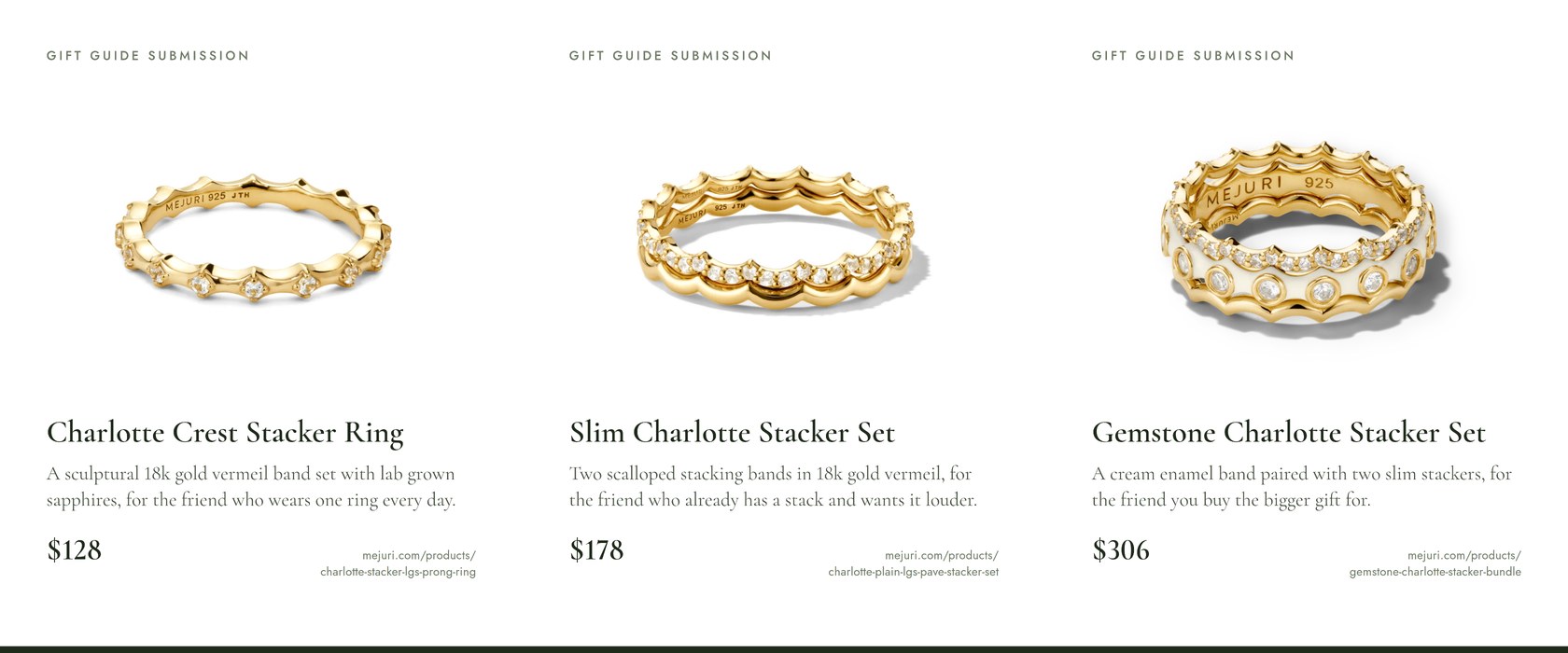
What comes outOne card per product. Image, line, price, link. Nothing else.
What do you need before you start?
Three things, and two of them already exist.
- Your product page links. One per product you want to pitch. That is the only product input. You do not need to find the photo files, export anything, or reshoot.
- The name of a real editor. A pitch addressed to nobody reads as a mailing list. Look at who wrote last year's guide for the outlet you want and use her name.
- A decision about which market. If you sell in more than one country, pick the one the outlet publishes in, because the price and the link both have to match it.
You do not need a photographer, a designer, a PR agency or a lookbook. You need Claude and about ten minutes.
What does an editor actually need?
Four things. This is the entire list.
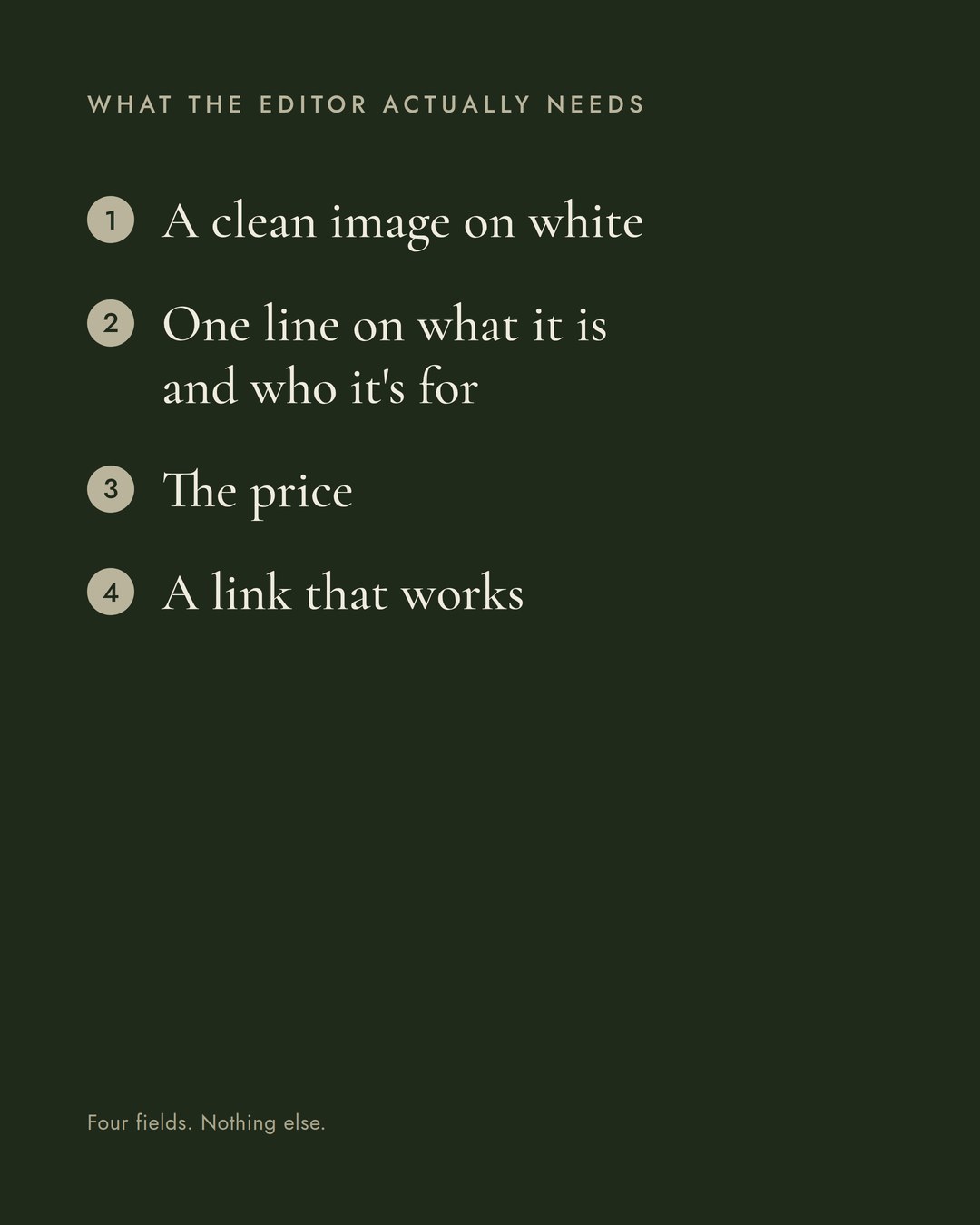
The whole specFour fields. Everything else is something she has to read past.
- A clean image on white. The whole product, centered, large enough to print.
- One line on what it is and who it's for. Roughly twenty words, written so she can use it as written.
- The price. In the currency the outlet publishes in.
- A link that works. To the product page, not the homepage, not a collection.
Send anything else and you get skipped. Not rejected, skipped, which is worse because you never find out. An editor is filling a slot, not meeting a brand.
When are holiday gift guide deadlines?
There is no single date, and the tiers are months apart. This is where most brands get the timing wrong in both directions at once, pitching print too late and assuming digital has already closed.
| Tier | Example | What they published |
|---|---|---|
| Print and trade | The Toy Insider holiday guide | Submissions May 14 to June 18 |
| Print and trade | Gift Shop Plus, Fall issue | Closed July 24 |
| Broadcast | FOX holiday gift guide | Samples through October 9 |
| Consumer lifestyle | Most of the ones you actually want | No published deadline at all |
That last row is the one that matters. The big consumer titles do not run a submission portal, so there is no date to miss and no form to fill in. They are pitched by email to a named editor, which means the thing standing between you and a slot is the quality of the pitch, not the calendar. It also means you can start today.
The five steps
In order. Each one is a single message.
| Step | What you do | How long |
|---|---|---|
| One | Paste your product links | 1 minute |
| Two | Ask for the images | 3 minutes |
| Three | Ask for the line and the price | 2 minutes |
| Four | Ask for the pitch email | 2 minutes |
| Five | Have it read back as the editor | 2 minutes |
Step onePaste the links and let the product pages do the typing
Do not type your own product names and prices. Every number you retype is a number that can be wrong, and a price on your submission that does not match the price on the page it links to is the single fastest way to lose an editor's trust.
Step twoAsk for the images
This is the step that decides whether the submission is usable, and it is almost entirely about the background. Your product page photos are probably already shot the right way. They are just sitting on the wrong white.
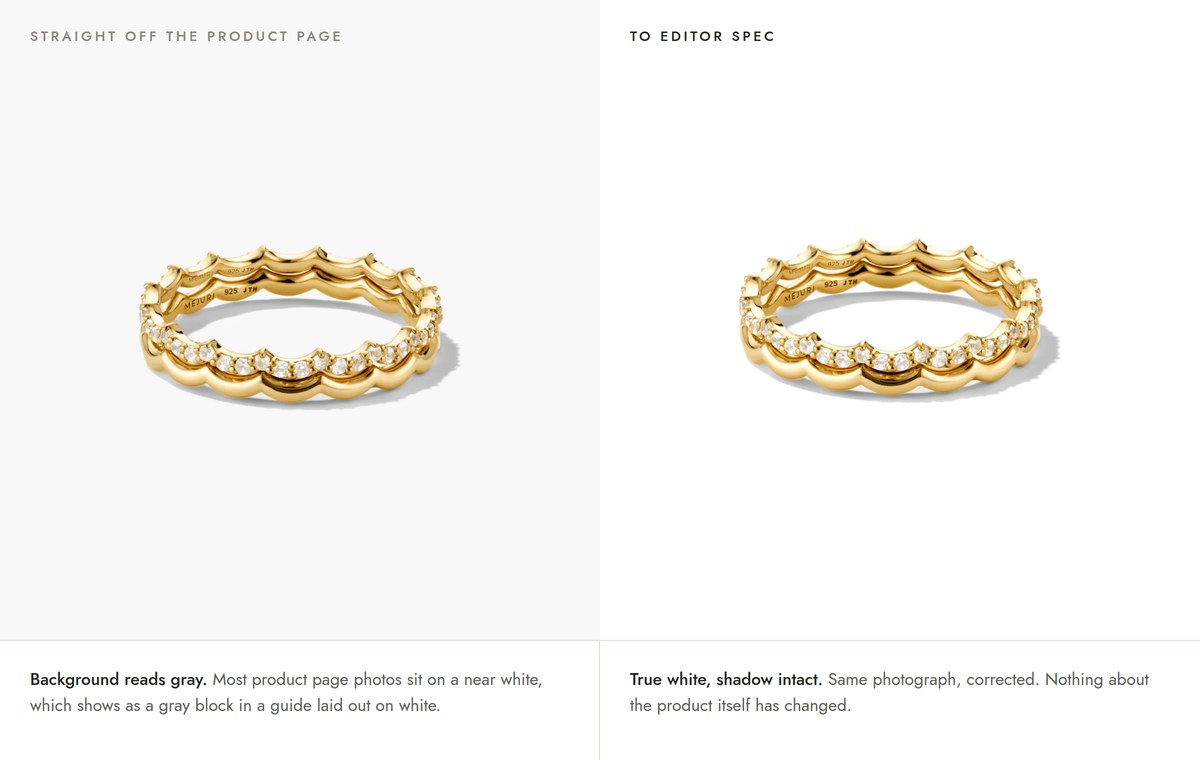
The difference is the background, not the productSame photograph both times. Only the white changed.
Look at the left side. That is a normal product page image and it looks fine on its own. Put it in a guide laid out on white, next to five other brands, and it reads as a gray box. That is the whole problem, and it takes one instruction to fix.
Ask to see them side by side at full size before anything gets saved. A halo around a product or a shadow that only one image has is invisible in a small preview and obvious in a published grid.
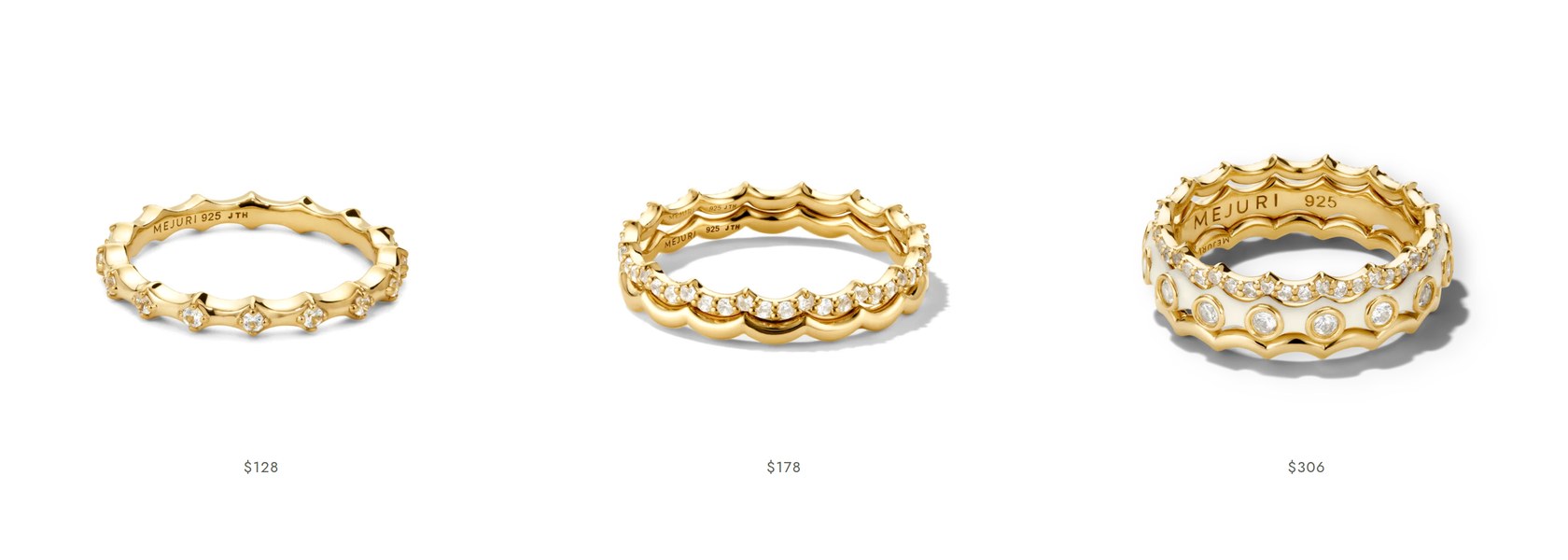
The set, checked togetherTrue to size against each other. Matching shadows. One group, not three files.
Step threeAsk for the line and the price
Twenty words that an editor can use as written. The test is whether she would have to rewrite it before it could go in the guide, because if she would, she will use a different brand's line instead.
"For the friend who wears one ring every day" can go into a guide untouched. "An elevated everyday essential that redefines modern luxury" cannot, and the editor will not fix it for you.
Step fourAsk for the pitch email
The email has one job, which is to be easy to lift from. Everything about the structure below exists so that an editor can select one product block, copy it, and paste it into her draft.
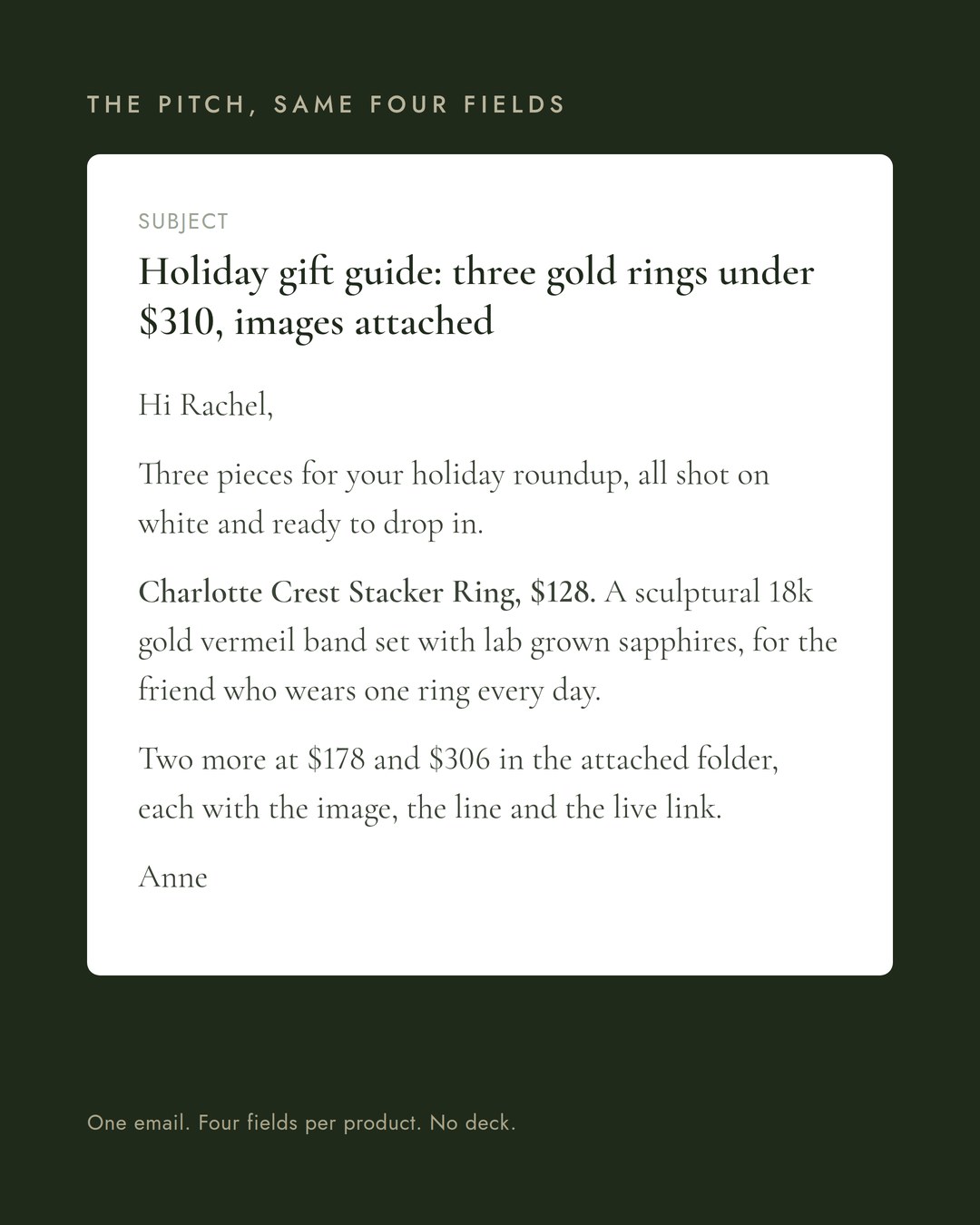
The emailSame four fields as the card. One screen, no attachments beyond the images.
Step fiveHave it read back to you as the editor
You cannot judge your own submission, because you already know what everything means and you already believe in the product. So have it read cold, by someone with no time and no reason to be kind.
Ask to be shown the results, not told they passed. It is worth building into every prompt where a number matters.
OptionalPitch a second marketOptional
If you sell into more than one country, the images are already done. Only the price and the link change, and both have to change together.
What is the prompt chain?
In order, so you can run the whole thing without stopping to think about what comes next.
| Prompt | What it does | What you get |
|---|---|---|
| One | Reads your product pages | Real names, prices and materials |
| Two | Puts every product on true white | One print sized image per product |
| Three | Writes the line, builds the card | Image, line, price, link on one card |
| Four | Writes the email | A one screen pitch she can copy from |
| Five | Reads it back as the editor | Pass or fail on all four, links opened |
| Six | Repeats for another country | A second set, images reused |
What makes the difference?
- Pure white, not the white your product page uses. Near white reads as a gray block once it is placed on a white page next to other brands.
- One window, not one frame per product. Crop everything from the same window so a ring does not end up the same size as a candle.
- The line names a person. "For the friend who wears one ring every day" beats any sentence containing the word elevated.
- Price band in the subject line. She is filling a slot under a number before she is choosing a brand.
- Never retype a price. Let the product page be the source, then check the card against the page it links to.
- Nothing in the email that is not one of the four. A founder story is not a rejection, it is a reason to stop reading.
What does this replace?
Gift guide seeding is one of the line items on a consumer PR retainer, and in my experience those retainers start in the low thousands a month and climb from there. Some of what that buys is genuinely hard to replicate: a list of editors, and a relationship with them that means an email gets opened.
The rest of it is production. Making the images, writing the lines, assembling the submission, sending the follow up. That half is what this replaces, and it is the half you were paying a monthly fee for whether or not anything ran.
One honest limit. A good submission gets you considered, it does not get you placed. What gets you placed is a product an editor believes her reader will buy, at a price that fits the slot she is filling. The submission's whole job is to make that judgment easy and fast. It cannot make the judgment come out in your favor.
The checklist before you send
- Every image on pure white, the whole product visible, at least 2000 pixels on the long edge
- Every product at true scale against the others in the set
- Same shadow treatment across every image
- One line per product, around twenty words, usable as written
- Price in the currency the outlet publishes in
- Every link opened and checked, and every price matching the page it links to
- Addressed to a named editor at a named outlet
- One screen. No deck, no lookbook, no founder story
When are holiday gift guide deadlines?
There is no single date, and the tiers are months apart. Print and trade guides close first and they close early. The Toy Insider took holiday submissions from May 14 to June 18. Gift Shop Plus closed its Fall issue on July 24. Broadcast runs later, and the FOX holiday gift guide accepts samples through October 9. Most consumer lifestyle titles publish no deadline at all, because they are not running a submission portal. Those are pitched by email to an individual editor, which is why the pitch itself has to be right rather than early.
What does an editor need in a gift guide submission?
Four things. A clean image on white, one line saying what the product is and who it is for, the price, and a link that works. That is the whole list. An editor is filling a slot in a layout, not evaluating a brand, so anything that does not go into the layout is something she has to read past. A lookbook, a founder story and a request for a call are all things she has to read past.
What kind of product photo do gift guides want?
The whole product, centered, on pure white, large enough to print. Guides run products in a grid at a consistent size, so a lifestyle photograph cannot be used no matter how good it is. The detail that catches most brands out is that a product page photo usually sits on a near white rather than a true white, which reads as a gray block once it is placed on a white page next to other brands' images. Correcting that is the difference between an image an editor can drop in and one she has to fix first.
Do you need a PR agency to get into a gift guide?
No, and the part an agency is genuinely useful for is not the part most brands think. What an agency really sells is a list of editors and a relationship with them. What it also does, and bills for, is producing the images and writing the submission, and that half is now something you can do yourself in an afternoon. Build the submission first. Then decide whether you are paying for access to editors or paying someone to make files you already have.
How long should a gift guide pitch email be?
One screen. A subject line that carries the price band, one paragraph per product with the name and price in bold, the one line underneath, the link on its own row, and a final sentence offering samples. That is it. Structure it so the editor can copy a whole product block straight into her draft, because the easier your email is to lift from, the more likely it is to be the one she lifts from.
The submission shown on this page was built as a demonstration using Mejuri's publicly published product photography, product names and retail prices. Mejuri is not a client of mine and I am not affiliated with the brand. I am a customer and a fan. The pitch email, the editor name in it and the descriptive lines are mine, not Mejuri's, and no part of this was commissioned by or shown to the brand. Deadline dates in the table were published by the outlets named beside them.